Interior Detailing

Pet Hair, Beach Sand, and Spilled Coffee

Three messes we see constantly in Nashua-area cars — and three different bills. Here's what each one actually adds, how long the work takes, and what you can do before drop-off to bring the number down.

Almost every interior detail we book in Nashua comes down to one of three things: the dog rides in the car, somebody has been going to the beach, or a coffee went over on Route 3. Often all three, in the same vehicle, in the same season.

People usually ask what an interior detail costs as though it's one number. It isn't — and the reason matters more than the price itself. Interior cleaning is sold by the hour of hands-on labor, and those three messes take wildly different amounts of it. Pet hair is slow to remove and nearly impossible to rush. Sand is fast if you catch it and stubborn if you don't. Coffee is cheap the week it happens and expensive the year after.

This is the breakdown we'd want as a customer: what each mess does to the labor, what a realistic outcome looks like, how long you'll be without the car, and where the money actually goes.

The Short Version

  • Baseline: interior detailing at our Derry shop starts at $199, and Nashua drivers pay the same as everyone else — there's no surcharge for the drive.
  • Pet hair adds the most time of the three. Fine undercoat has to be broken out of the fabric before a vacuum can touch it, which is an extra step before the cleaning even starts.
  • Beach sand is inexpensive to handle early and gets pricier the longer it grinds into the carpet base and the seat rails.
  • Coffee is priced by the calendar. Fresh and blotted is minor. Soaked into the padding and left for months is extraction plus drying time.
  • What actually sets your number: vehicle size, how many of the three you're stacking, and whether anything soaked through to the foam underneath.
Why the Mess Sets the Price, Not the Car

A base interior detail is a defined scope of work: a full vacuum, shampoo of the carpets, seats, and panels, door jambs, interior glass, and a wipe-down of the dash, console, and vents. That's the job our interior detailing package covers from $199, and for a car that's simply overdue, it's the whole appointment.

What pushes a quote above that isn't the badge on the trunk. It's how many extra passes the car needs before the standard scope can even begin. Every one of the three messes in this article creates a pre-step — something that has to happen before normal cleaning works at all:

  • Hair has to be lifted out of the weave before vacuuming does anything.
  • Sand has to be brought up from the base of the carpet pile before extraction can pull it out.
  • Set-in spills have to be pre-treated and drawn out of the fiber, and sometimes dried, before the seat is finished.

Vehicle size still matters, because a three-row SUV has roughly twice the carpet and upholstery of a compact sedan and every step takes proportionally longer. But between two identical vehicles, condition is the bigger variable by far. We covered the general mechanics of detailing pricing in what car detailing near you actually costs; this post is the interior-specific version of that math.

Pet Hair: The Most Labor of the Three

If you've ever vacuumed your back seat for twenty minutes and found it looked essentially the same, you already understand the problem. Loose hair on the surface comes up easily. The hair that stays is fine undercoat that has worked its way into the weave of the fabric, and it's held there by static, not by gravity. Suction passes straight over it.

Getting it out is a mechanical process. Rubber extraction tools and stiff brushes are dragged across the fabric to break the static bond and roll the embedded hair up into clumps, which are then vacuumed away. Then it's done again, because the first pass never gets it all, and again on the areas that shed the most — the rear bench, the cargo area, the seat backs, and the seams where hair collects like a drift.

That's why hair is priced the way it is. On a moderately used family vehicle it's an added step. On a car that hauls a heavy-shedding dog year-round, it can add an hour or two of work before any actual cleaning starts, and there's no product or machine that makes it fast. Anyone quoting you a flat, trivial add-on for a badly furred SUV either hasn't seen it or plans to do a partial job.

Light: Occasional Passenger

Hair on the surface and in the seat seams, but the fabric still looks like fabric. Usually absorbed into a standard interior detail without a meaningful change to the quote.

Moderate: Regular Rider

Visible hair woven into the rear seats and cargo carpet, and it reappears when you brush a hand across it. Adds a dedicated extraction pass and real time on top of the base service.

Heavy: Daily, Year-Round

Hair packed into the pile, the seat seams, the belt anchors, and the cargo trim. This is the version that adds hours, and the honest expectation is "dramatically better," not "showroom." A last few strands surface later.

One useful piece of context: hair and pet odor are two separate jobs. Removing every strand doesn't remove the body oils in the upholstery or a past accident that soaked into padding — that's an odor treatment, not a hair removal. If pet hair is your main issue, our guide to getting dog hair out of a car for good goes deeper into the technique and what keeps it from coming back.

Beach Sand: Cheap Early, Expensive Later

Nashua is an easy run to Hampton, Salisbury, and the Maine beaches, and by late August it shows in the footwells. Sand is the mess people most consistently underestimate, because the part you can see is a small fraction of what's in the car.

Sand doesn't sit on carpet. It sinks. Vibration from driving works it down to the base of the pile, where a household vacuum's suction can't reach past the fibers standing above it. From there it migrates — into the seat track channels, under the seat rails, into the gap at the sill plate, into the rear seat folds, and down the sides of the center console. That's why you're still finding sand in October from a July trip.

The professional version of this job is air, agitation, and extraction: compressed air to blow sand out of the tracks, rails, and crevices where it's hiding, a brush or pile lifter to bring it up out of the carpet base, then extraction to pull it and the fine grit out of the vehicle rather than redistributing it. Seats get slid fully forward and fully back, because half the sand lives in the strip of carpet you can't normally see.

The cost curve on sand is the friendliest of the three if you act on it. Handled while it's still loose, it folds into a standard interior detail. Left through a full season of driving, it grinds against the carpet fibers every time someone steps in, dulls and frays the pile, and works into the seat foam — at which point you're paying for more labor and getting a less complete result. This is the single best argument for booking the interior work in late summer or early fall rather than waiting.

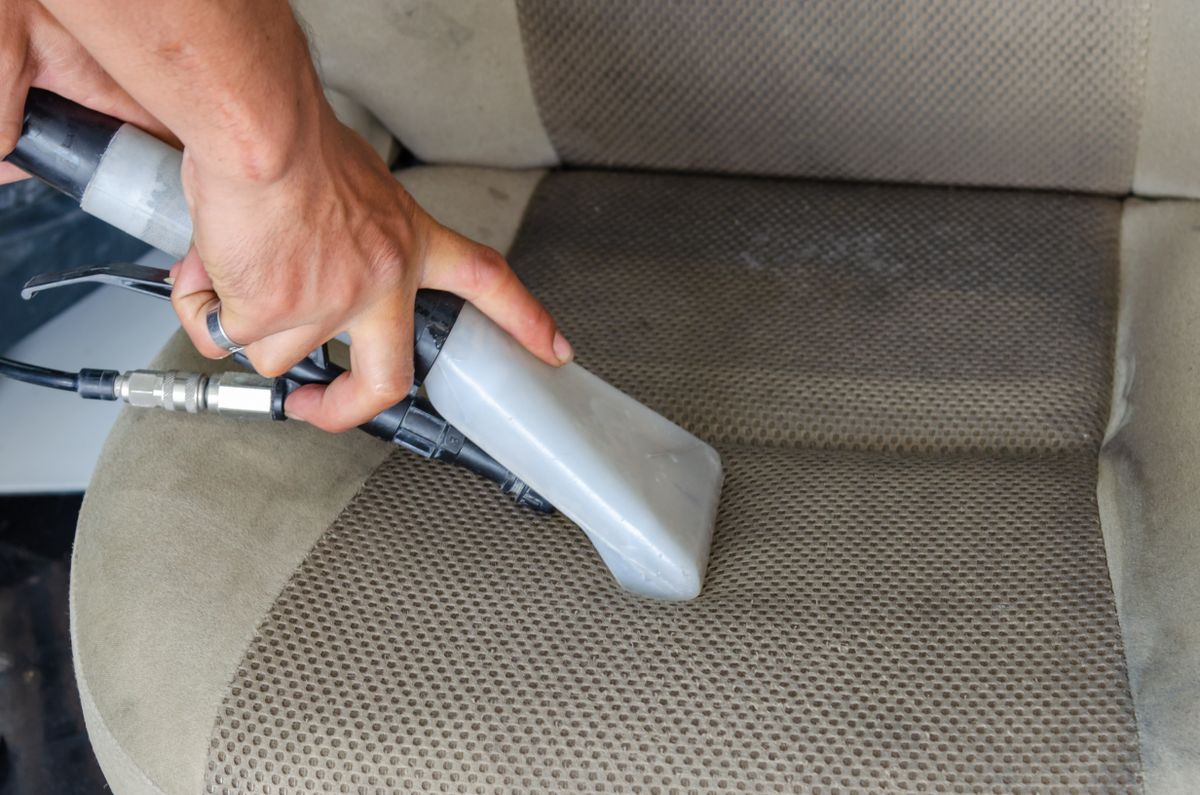
Hands guiding a hot-water extractor wand across a beige fabric car seat, leaving a visibly cleaner stripe in the soiled upholstery

Hot-water extraction is where most of an interior detail's labor actually goes — the soil is drawn out of the fabric and back into the machine rather than scrubbed deeper into the foam underneath.

Spilled Coffee: Priced by How Long Ago It Happened

Coffee is the most forgiving of the three and the one people most often make worse. It's water-based, which is good news — hot-water extraction lifts it out of cloth well, even months later. What complicates it is everything that rides along with it.

Sugar leaves a tacky film that runs down into console seams and door pockets and re-forms every humid day. Cream or milk leaves organic residue that keeps producing a sour note as it breaks down, which is why a stain that looks gone can still smell. And a full cup doesn't stay on the surface: it runs through the seat cover into the foam beneath, or through the carpet into the padding, where a surface clean never reaches.

  1. Fresh and blotted. You pressed a clean towel straight down and lifted the liquid out within a day. Usually part of a standard interior detail with no meaningful add-on.
  2. Dried on cloth, weeks old. Pre-treatment plus extraction on the panel. Realistic outcome is gone or very nearly gone. A modest amount of extra time.
  3. Soaked through to foam or padding. This is the one that changes the appointment. It needs extraction that pulls moisture and residue out of the padding, plus forced drying — otherwise you trade a stain for a musty smell. Expect a longer job and a higher number.
  4. On perforated leather. Liquid runs straight through the perforations into the foam below, so the surface can look clean while the source of the smell sits underneath. Handled properly, and with conditioning afterward so the cleaner doesn't leave the leather dry.
Don't Do This

The most expensive thing you can do to a coffee spill is scrub it, and the second most expensive is soak it with a rental carpet machine. Scrubbing drives the stain deeper into the padding and frays the fiber, which leaves a permanent fuzzy patch even after the color comes out. Rental units inject far more water than they recover, so the padding stays wet for days and you end up with mildew on top of the original problem — a job that now costs more than the stain ever would have. Blot, don't rub, and leave the wet work to a machine that pulls the water back out.

If your interior complaint is really a smell rather than a stain, it's worth reading our guide to diagnosing what's wrong inside your car first — some odors aren't a cleaning problem at all, and knowing which is which keeps you from paying for the wrong service.

What Actually Moves Your Number

Beyond the three messes themselves, five things decide where a quote lands. None of them are mysterious, and a shop that can't explain them is a shop worth skipping.

  • Vehicle size. A three-row SUV or a crew-cab truck has far more carpet, upholstery, glass, and crevice work than a compact sedan. Every step scales with it.
  • How many messes stack. One issue is an add-on. Dog hair plus a summer's worth of sand plus a spill in the third row isn't three add-ons — it's a substantially longer appointment, because each one has to be handled before the next step works.
  • Whether anything soaked through. This is the biggest single divider. Surface soil is straightforward. Anything that reached the foam or padding needs extraction and drying time, which is a different process, not just more minutes.
  • Material. Cloth absorbs and needs extraction. Leather and vinyl resist absorption but need conditioning afterward, since cleaning strips the finish. Perforated leather is its own case, as above.
  • Add-on scope. Odor removal uses steam and optional ozone for smells that survive a standard clean. Upholstery care conditions leather or fabric afterward. If the outside needs attention in the same visit, the full service detail starts at $299 and covers both in one appointment rather than two.

Notice what isn't on that list: your zip code. Nashua drivers pay the same as Derry, Londonderry, or Salem drivers — the work is the work, and the drive isn't your problem to fund. Our Nashua detailing page covers the logistics side, including drop-off timing for the office parks.

Timing: How Long It Takes and When to Book

Plan on most of a day for a real interior detail, and a full day if you're stacking two or three of the messes above. This is not a service that gets better by being rushed, and drying time in particular can't be compressed — a seat that goes back together damp becomes a smell complaint two weeks later.

For the drive from Nashua, our shop in Derry is about 25 minutes via Route 28 and the Everett Turnpike. The pattern that works best for commuters: drop the car on the way in, pick it up after work. If your morning starts before we open, a key drop handles it. Either way, you're not sitting in a waiting room for six hours.

The Seasonal Windows That Matter

  • Late August through October — the best interior window of the year. Beach sand is still loose rather than ground in, summer spills are recent, and you're cleaning the cabin before five months of road salt, slush, and wet boots get tracked in. Going into winter with clean carpet also makes the spring cleanup smaller.
  • March and April. The salt-and-sand recovery appointment. Winter grit in the footwells behaves a lot like beach sand and comes out the same way.
  • Two to three weeks before you list a car for sale. Far enough ahead that any odor treatment has fully aired out, close enough that the result still shows at the showing.
  • Immediately after a real spill. The cheapest interior appointment you will ever book is the one that happens before the liquid finishes soaking into the foam.

One scheduling note worth knowing: late spring is the busiest stretch of the year for every detail shop in southern New Hampshire, and interior-only jobs are the first thing that gets squeezed when the calendar fills. Booking your interior work in the fall usually means a shorter wait and a more flexible date.

Five Things to Do Before Drop-Off That Lower the Bill

You're paying for hours. Anything that removes an hour from the job removes it from the price, and none of this takes long.

  1. Empty the car completely. Trunk, door pockets, glovebox, the space under the seats, the cargo area. Time spent relocating your belongings is time not spent cleaning, and it's billed the same.
  2. Pull the floor mats and knock the sand out. Five minutes against a curb removes a genuinely surprising volume of grit before it ever reaches the shop.
  3. Blot anything fresh — never scrub. A clean white towel pressed straight down lifts liquid out. Rubbing pushes it into the padding and permanently damages the fiber, converting a cheap fix into an expensive one.
  4. Take a few photos of the worst spots. The stain, the furred cargo area, the sandy footwell. Send them with the quote request.
  5. Tell us what happened and roughly when. What spilled, how long ago, whether it reached the carpet, whether pets ride in it, whether anything has ever soaked. That's what separates a real number from a range.
A Fair Warning About Quotes

A firm price given sight-unseen and without questions is a yellow flag, not a convenience. A shop that commits to an exact number without knowing whether your carpet padding is soaked is either padding the estimate for the worst case or planning to stop short when the work turns out to be bigger than the price. The better experience is a transparent quote built around your actual vehicle — describe it, send photos, get a number that holds.

Is It Worth It?

Fair question, and the honest answer depends on what you're buying. If the goal is "the car looks tidy for the weekend," a careful hour in your own driveway gets you most of the way there and costs nothing. That's a legitimate choice, and we'd rather say so than pretend otherwise.

What a professional interior clean buys is the part a driveway session structurally can't do: extraction that pulls soil and moisture out of the car instead of pushing it deeper, compressed air into the tracks and vents, controlled drying so nothing goes back together damp, and products matched to each material rather than one all-purpose spray that hazes plastic and dries leather. Those are equipment and process differences, not effort differences.

The math tends to favor booking it in three situations: when a smell or stain has already survived one of your own attempts, when the interior is heading toward permanent damage — sand abrading carpet, a spill sitting in foam, sun-baked residue on a dash — and when you're about to sell or trade the vehicle, where a clean interior is one of the first things a buyer reacts to. Outside those, a maintenance detail once or twice a year is plenty for most cars around here.

Frequently Asked Questions

How much does professional interior cleaning cost in Nashua, NH?
Interior detailing at our Derry shop starts at $199, and Nashua drivers pay the same as everyone else — there is no surcharge for the drive. Where your number lands above that start depends on vehicle size and condition. A tidy commuter sedan that needs a seasonal reset sits near the bottom. A three-row SUV carrying a season of dog hair, beach sand in the rear footwells, and a coffee spill that soaked into the padding is several more hours of hands-on labor, and it prices accordingly.
Why does pet hair cost extra when it is just vacuuming?
Because it is not vacuuming. Fine undercoat hair works its way into the weave of the fabric and is held there by static, so suction alone passes right over it. Getting it out means working the surface with rubber extraction tools and brushes to break the hair free first, then vacuuming, then repeating on the areas that shed the most. On a heavily used family vehicle that step alone can add an hour or two before any actual cleaning starts, and labor is what you are paying for.
Can beach sand be fully removed from car carpet?
In most cases, yes — but not with a shop vacuum. Sand sinks to the base of the carpet pile and migrates into the seat tracks, the seat-rail channels, and the gaps at the sill plate, which is why you keep finding it weeks after the last beach trip. Removing it takes air, agitation of the pile, and extraction, often with the front seats slid all the way forward and back. The longer it stays, the more of it grinds into the fibers, so an early appointment costs less than a late one.
Is a coffee stain still removable months later?
Usually, though the outcome and the price both change with time. Coffee is water-based, so hot-water extraction lifts it out of cloth well. What complicates an older spill is what came with it: sugar leaves a tacky film in the seams, and dairy or creamer leaves organic residue that keeps producing odor as it breaks down. If the spill soaked through to the foam under the seat cover or the carpet padding, the job needs extraction plus forced drying rather than a surface clean, and that is a longer appointment.
How long does an interior detail take, and can I drop off before work?
Plan on most of a day. A standard interior detail is a multi-hour job, and adding heavy pet hair, sand extraction, or a stain that needs drying time pushes it toward a full day. Most of our Nashua clients drop the car at our Derry shop on the way in — about 25 minutes via Route 28 and the Everett Turnpike — and pick it up after work. If your commute starts before we open, we can arrange a key drop.
What can I do before the appointment to keep the price down?
Empty the car completely, including the trunk, door pockets, and the space under the seats, because time spent moving your belongings is time not spent cleaning. Take the floor mats out and knock the loose sand off them. Blot any fresh spill rather than scrubbing it. Then send photos of the worst areas with your quote request and describe what happened and roughly when. Those five minutes are the difference between a real number and a range.

The Bottom Line

There isn't one price for an interior detail, because there isn't one interior. Pet hair costs time and can't be hurried. Sand is inexpensive to handle while it's loose and increasingly expensive once it's ground in. Coffee is priced by how long it's been sitting and whether it reached the foam. Start from the $199 interior baseline, add honestly for what's actually in your car, and book the appointment in the fall window when the calendar is open and the mess hasn't set. Empty the car, send a couple of photos, describe what happened — and the quote you get back will be a number rather than a guess.

"You're not paying for products. You're paying for the hours the mess demands."

— The Avid Auto Standard

Get a Real Number for Your Interior

Tell us what's in the car — the hair, the sand, the spill — and we'll quote the actual job, not a range.

Get Free Quote

About Avid Auto Detailing

Arthur and the Avid Auto Team detail vehicles from our climate-controlled shop at 15 Central St in Derry, NH, about 25 minutes from Nashua via Route 28 and the Everett Turnpike. Interiors are a large share of what rolls through our bays — pet hair, beach sand, spills, and the moisture problems New England weather adds to all three — and every quote starts with looking at the car rather than guessing at it.

Fully Insured and backed by a 5.0-star rating from 100+ Google reviews. Interior work, exterior work, paint correction, and ceramic coating all run out of the same shop — see the full scope on our auto detailing page.

"Detail Obsessed – Eco-Smart Products"