Paint Protection

Tree Sap, Bug Splatter, and Bird Droppings: Is Your Paint Just Dirty or Actually Etched?

A five-minute test that tells you whether the mark is still sitting on your paint or already cut into it — and what each answer costs.

You washed the car and the marks are still there. A cloudy ring on the trunk where a bird got you three weeks ago. A haze of dark speckles across the front bumper from the drive back from the lake. A patch of hard little domes on the roof from parking under the same pine in the Derry town lot all summer.

The question that decides everything is simple: is that stuff still sitting on top of your paint, or has it already eaten into it? One answer means a bottle of the right product and twenty minutes on a Saturday. The other means a machine polisher, because the mark is no longer a substance — it's a shape in your clear coat.

Most people can't tell the difference by eye, so they either scrub something that will never come off or pay for correction they didn't need. Here's how to find out for certain before you spend anything.

The 30-Second Version

  • Residue — the contaminant is still physically on the paint. It feels raised or crusty, casts a tiny shadow in low light, and the right chemistry removes it completely. Free to fix at home.
  • Etching — acid has dissolved a shallow crater into the clear coat. It feels level or slightly dished, it vanishes when the panel is wet and reappears as it dries, and no product on earth wipes it away. Machine polishing only.
  • Through the clear coat — rare, and usually the result of months of neglect on a hot horizontal panel. A permanently dull or discolored patch that polishing can't reach. Refinishing territory.

Two of those three you can identify in your own driveway with a hose and a fingertip. Let's do that first, then get into what causes each one and how fast it happens in a New Hampshire summer.
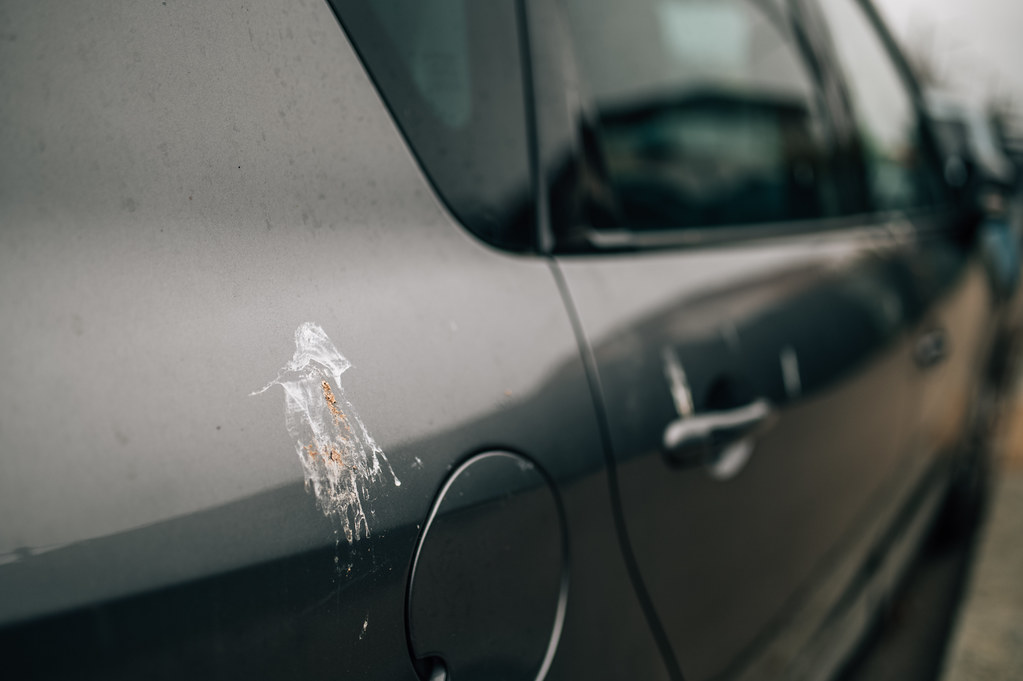
Dried bird dropping streaked down the dark grey paint of a car's rear quarter panel beside the fuel filler door, with dust and water spotting on the surrounding clear coat

This is the moment the clock is running. Dried onto a warm panel, the streak is still removable — but the outline it leaves behind after washing is what tells you whether the clear coat underneath survived.

Photo by Ivan Radic — source, CC BY 2.0

Why This Mess Is Different From Dirt

Road dust, pollen, and brake dust are inert. They sit on your paint, they look bad, and they wash off. Sap, bugs, and bird droppings are chemically active — each one attacks the clear coat in its own way, and each one gets dramatically worse with heat.

Bird Droppings

The fastest and most damaging of the three. Droppings are acidic and often carry grit and seed fragments that scratch on contact. Worse, clear coat expands in the sun and then contracts as it cools, drawing the dropping down into the softened surface. That's why the outline is frequently still there after the solid material is long gone.

Bug Splatter

Insect remains are acidic too, and they land on the hottest, most wind-blasted panels on the car: bumper, hood, mirrors, and the leading edge of the roof. Heat bakes them into a hard crust within a day or two. The damage is usually a cluster of tiny pinpoint etches rather than one big mark.

Tree Sap

Sap is resin, not acid, so it works differently. It hardens on the panel and shrinks as it cures, gripping the clear coat and pulling on it. Given weeks in the sun, that hardened bead can leave a dull ring or a slightly deformed spot even after the sap itself is removed. Sap is also the one people most often make worse by picking at it.

One thing all three share: the damage isn't done by the mess sitting there, it's done by the mess sitting there in the sun. A shaded car in Londonderry and a car parked all day in an open lot off Route 28 in Salem can pick up identical droppings and end up with completely different outcomes.

How Long You Actually Have

People want a number. There isn't a clean one, because the variable that matters most isn't time — it's panel temperature. Here's the honest version based on what comes through our shop:

Contaminant Cool, shaded panel Hot panel in direct sun
Bird dropping Often wipes off clean after a day or two Can leave a visible outline in a matter of hours
Bug splatter Rinses off easily the same day; crusts within a few days Bakes hard within a day; pinpoint etching within a week
Tree sap Softens and releases with solvent for weeks Cures hard in days; can dull the spot over a few weeks

The practical rule that comes out of that table: bird droppings are a same-day job, bugs are a same-week job, and sap is a same-month job. Miss those windows on a hot panel and you've moved from cleaning to correcting.

Reality Check

The single most common version of this we see is a car that looked fine all summer because the owner never inspected the horizontal panels. Roofs, hoods, and trunk lids take the sun, the sap, and the droppings, and they're the panels you never look straight down at. Walk around your own car once a month and actually look at the roof.

The Five-Minute Test: Residue or Etching?

Do this after a normal wash, on a clean, dry, cool panel. You need water, a clean microfiber, and daylight or a flashlight held at a low angle.

  1. Wash the area properly first. Not a wipe — a real wash with car soap and a clean mitt. You cannot diagnose paint through a film of road grime, and half of what people call etching turns out to be residue that a proper wash removes.
  2. Feel it with a clean fingertip. Raised, crusty, or tacky means the contaminant is still there. Perfectly level, or a faint dish you can just feel the edge of, means the paint itself has changed shape.
  3. Wet the panel and watch. Pour water over the mark. If it disappears completely while wet and fades back in as the panel dries, that's a shallow etch — water is filling the crater and restoring even reflection, exactly what a polish will do permanently.
  4. Use raking light. Stand so the sun or a flashlight beam skims the panel. Residue casts a small shadow and sits proud of the surface. Etching reads as a dull ring, a halo, or a matte crater with a normal-gloss center.
  5. Do the baggie check on the whole panel. Put your hand in a thin sandwich bag and glide it over the paint. Gritty or bumpy across a wide area means bonded contamination that a decontamination and clay treatment removes — a different job from spot etching, and much cheaper.

If steps two through four all say "the substance is gone but the mark isn't," you have etching. That's not a diagnosis to panic over — most of it polishes out — but it does mean no product you buy is going to fix it. This is the same logic we use to separate swirls from spots and haze; if you're seeing more than one kind of defect on the car, our breakdown of why paint looks swirled, hazy, or spotted covers the other three.

If It's Still Residue: Removing Each One Safely

Every one of these follows the same principle — dissolve, don't abrade. Soften the contaminant with the right chemistry and let it release. Pressure is what turns a cleaning job into a scratching job.

Bird droppings

  • Work in the shade on a cool panel. Never attack a dropping on a hot hood.
  • Soak first. Lay a microfiber soaked in warm water or quick detailer over the dropping for 30 to 60 seconds so the crust rehydrates and the grit floats free.
  • Lift, don't drag. Fold the towel, wipe once in a single direction, then refold to a clean face. Never wipe back and forth with the same section — that grinds seeds and grit across the paint.
  • Rinse the area, dry it, and re-apply whatever protection you use. If the dropping had been there a while, the acid stripped the wax or sealant in that spot.

Bug splatter

  • Pre-soak the bumper and the leading edge of the hood with a dedicated bug remover before you wash the car, and give it the full dwell time on the label.
  • Keep the panel wet the entire time. Bug remover drying on paint is its own problem, especially in sun.
  • Use a soft bug sponge or plush microfiber, never a mesh scrubber. Mesh removes bugs and clear coat with equal enthusiasm.
  • Two gentle passes beat one hard one. If a crust survives twice, it's baked in and probably etched underneath — stop scrubbing.

Tree sap

  • Do not pick it with a fingernail, and do not scrape it with anything. Hardened sap is harder than your clear coat.
  • Use a dedicated sap and tar remover, or isopropyl alcohol diluted to roughly 20–30% with water on fresh sap. Apply it to the towel, not the panel.
  • Lay the wet towel over the deposit and wait 30 to 60 seconds. Solvent needs dwell time; that wait is the whole trick.
  • Wipe in one direction with light pressure. Repeat the soak rather than increasing pressure.
  • Wash and re-protect afterward. Solvents strip wax, sealant, and even the top of a coating's sacrificial layer.

Three things to never do, all of which show up in our shop regularly: don't use a razor blade or plastic scraper on sap, don't use acetone or lacquer thinner on modern clear coat, and don't try to melt sap off with hot water on a cold panel in fall — thermal shock on glass and trim is a real risk in New Hampshire once nights get down near freezing.

If It's Etched: What Actually Fixes It

Etching is geometry, so the fix has to change geometry. A machine polisher with a compound removes a few microns of clear coat across the panel until the surface is level with the bottom of the crater. Even surface, even light reflection, mark gone. Nothing that sits on top of the paint — wax, glaze, spray sealant, "scratch remover" — can do that, though fillers will hide light etching for a few weeks and convince you the problem is solved.

What that costs depends entirely on scope, and this is where an honest shop should slow you down rather than upsell you:

  • A handful of spots on one or two panels. Often handled as a spot correction during a regular exterior detail. This is the cheapest outcome by a wide margin, and it's the reason catching it early matters.
  • Scattered etching across horizontal panels. Roof, hood, and trunk from a season under trees. Typically a single-stage machine polish of those panels.
  • Etching plus swirls, haze, and water spots car-wide. Now you're in multi-stage correction, because you're fixing everything at once and the etching just happened to be what you noticed.

Before any of that happens, the paint has to be decontaminated — chemical iron removal plus a clay treatment — because polishing over bonded grit drags it across the panel and adds new scratches. That step alone resolves a surprising number of "etched" complaints. A thorough exterior detail with full decontamination is genuinely the right first appointment for most people reading this, because whatever is still visible afterward is real etching, and now you're making a correction decision with information instead of guesses.

The honest limit: correction removes material, and your car only has so much clear coat. Etching that reached the color layer shows as a permanently dull or discolored patch and can't be polished out. If your fingernail catches on the edge of a crater, or the spot has gone chalky white on a dark car, that's a refinishing conversation, not a detailing one. Any shop that promises to polish out everything on a decade-old daily driver either hasn't looked closely or is planning to cut deeper than they should.

Protection: What It Buys You, and What It Doesn't

The question that always follows a bad etching bill is whether protection would have prevented it. The truthful answer is that protection changes your timeline, not the chemistry.

Wax and sealant give you a thin sacrificial layer and a slicker surface, so contamination releases with less effort. Against a bird dropping baking on a hot hood for a week, that's a modest advantage — and in New Hampshire, wax applied in the fall is usually gone before the sap season it was meant to cover.

A ceramic coating is a meaningfully harder, more chemically resistant layer that's bonded to the paint rather than resting on it. Acid has to get through the coating before it reaches your clear coat, which converts a lot of same-day emergencies into next-weekend chores, and contamination releases far more easily during washing. What it is not is immunity. A dropping left on a coated panel through a hot week can still mark the coating, and severe cases still reach paint. Coating also has to go on correctly prepped paint to work at all — we walk through that in what happens before a ceramic coating goes on, and the coating options themselves are laid out on our ceramic coating page.

Paint protection film is the only one of the three that's a genuine physical barrier. It's typically applied to the panels that take the worst of it — front bumper, hood leading edge, mirrors — which is exactly where bug splatter concentrates. It costs more and covers less area, so it's a targeted solution rather than a whole-car one. Our paint protection film page covers where it makes sense.

If you're weighing these against each other, weigh them honestly: none of them replaces getting the mess off the car. The best protection strategy in southern NH is a coating plus the habit of rinsing droppings and bugs off the same week, and the worst one is any product bought as an excuse not to.

Timing It for a New Hampshire Year

This is a seasonal problem with a seasonal answer, and September is the pivot point.

  • Late summer into early fall is peak damage season. You've collected a full summer of bug splatter on the bumper, sap from pines and maples on the roof, and whatever landed on the trunk in July — all of it heat-cycled for months. This is when the etching that's going to exist already exists.
  • Early fall is the ideal window to deal with it. Panels are cool enough to work on safely, the bug and sap season is winding down, and anything you correct now gets a fresh coat of protection before the road salt starts. Correcting paint in March means it spent the entire winter unprotected.
  • Winter is the wrong time to discover it. Once brine season starts you're washing constantly and inspecting rarely, and a shop's schedule is full of salt-damage work. Etching found in January usually waits until spring regardless.
  • Spring is the second-best window — and it's also the busiest. Everyone in Derry, Londonderry, and Manchester books their detail the same three weeks in April, so a fall appointment is the shorter wait.

Between now and then, the highest-value habit costs nothing: keep a bottle of quick detailer and two clean microfibers in the trunk. Handling one dropping in the parking lot the day it happens is the difference between a wipe and a polish.

Frequently Asked Questions

How can I tell if bird droppings etched my paint or just left a stain?
Wash the spot, dry it, and then look at it two ways. Wet the panel again: if the outline disappears completely while the paint is wet and returns as it dries, you're looking at a shallow etch, because water is temporarily filling a dished-out area. Then run a clean fingertip over it. Residue feels raised or crusty; etching feels level or slightly sunken, and the mark is a dull ring or crater rather than a lump. Residue that survives a proper wash but feels smooth is almost always an etch.
How long do I have before a bird dropping damages my paint?
There's no fixed number, because heat and sun drive the reaction. On a cool, shaded panel a fresh dropping can sit for a day or two and wipe off with nothing left behind. On a hot hood in direct August sun, the clear coat softens and the same dropping can leave a visible outline in a few hours. The safe habit is simple: treat a dropping as a same-day job, and never let one bake through a sunny weekend.
What's the safest way to remove tree sap without scratching the paint?
Never pick, scrape, or dry-rub sap. Work on a cool panel in the shade, soak a folded microfiber with a dedicated sap or tar remover (isopropyl alcohol diluted to roughly 20–30% with water works on fresh sap), lay it flat on the deposit for 30 to 60 seconds so the solvent softens it, then wipe in one direction with light pressure. Repeat rather than pressing harder. Wash and re-protect the area afterward, because solvents strip whatever wax or sealant was there.
Does a ceramic coating stop sap, bugs, and bird droppings from etching paint?
It buys time; it doesn't make paint immune. A coating is a harder, slicker, more chemically resistant sacrificial layer, so contamination releases more easily and the acid has to get through the coating before it reaches your clear coat. That converts many same-day emergencies into next-weekend chores. But a dropping left baking on a coated hood for two weeks in July can still mark the coating, and severe cases can reach the paint. Coating changes the timeline, not the physics.
Can etched paint be fixed, or is it permanent?
Most of it can be fixed. Etching is a shallow crater in the clear coat, and machine polishing levels the surrounding clear coat down to the bottom of that crater so light reflects evenly again. Light and moderate etching usually comes out in a single-stage polish. What can't be corrected is etching that has gone all the way through the clear coat into the color layer, which shows as a permanent dull or discolored patch and needs refinishing rather than polishing.
Why do bugs seem to damage paint more in late summer?
Two things stack up. Insect activity peaks in the warm months, so you collect more splatter per mile on I-93 and Route 28, and the panels that catch it — front bumper, hood, and mirrors — are the hottest surfaces on the car. Heat both accelerates the acidic reaction and bakes the remains into a hard crust that's harder to remove without abrasion. A bug hit rinsed off the same evening is a non-event; the same hit left through a week of 85-degree afternoons is a polishing job.

The Bottom Line

Sap, bugs, and bird droppings all end the same way visually — a mark that won't wash off — but they're two completely different problems wearing the same face. Residue is a cleaning job you can do yourself this weekend with the right chemistry and no pressure. Etching is a shape in your clear coat, and shapes only change under a machine polisher.

Five minutes with a hose, a fingertip, and a low-angle light tells you which one you have. Do that before you buy a product, and definitely before you book anything.

If you'd rather have someone else make the call, bring it by. We're a small team working out of a climate-controlled shop at 15 Central St in Derry, and a walk-around under proper inspection lighting takes a few minutes. Plenty of the time the answer is "that comes off in a wash," and we'd genuinely rather tell you that than sell you a correction.

"Wash it before you judge it. Most of what looks like damage is still just sitting there."

— The Avid Auto Standard

Not Sure If It's Etched?

Send us a photo in raking light or bring the car by our Derry shop. We'll tell you whether it washes off, polishes out, or needs more — and quote you honestly either way.

Request a Quote

About Avid Auto Detailing

Arthur and the Avid Auto Team correct and protect paint from a climate-controlled shop at 15 Central St in Derry, NH, serving drivers across Derry, Londonderry, Manchester, Salem, and the Merrimack Valley. Interior and exterior packages start at $199, full service details at $299, with paint correction and System X Certified ceramic coating available once we've seen what your paint actually needs.

Fully Insured — a small team that would rather diagnose your paint correctly than sell you the biggest package on the menu.

"Detail Obsessed – Eco-Smart Products"